

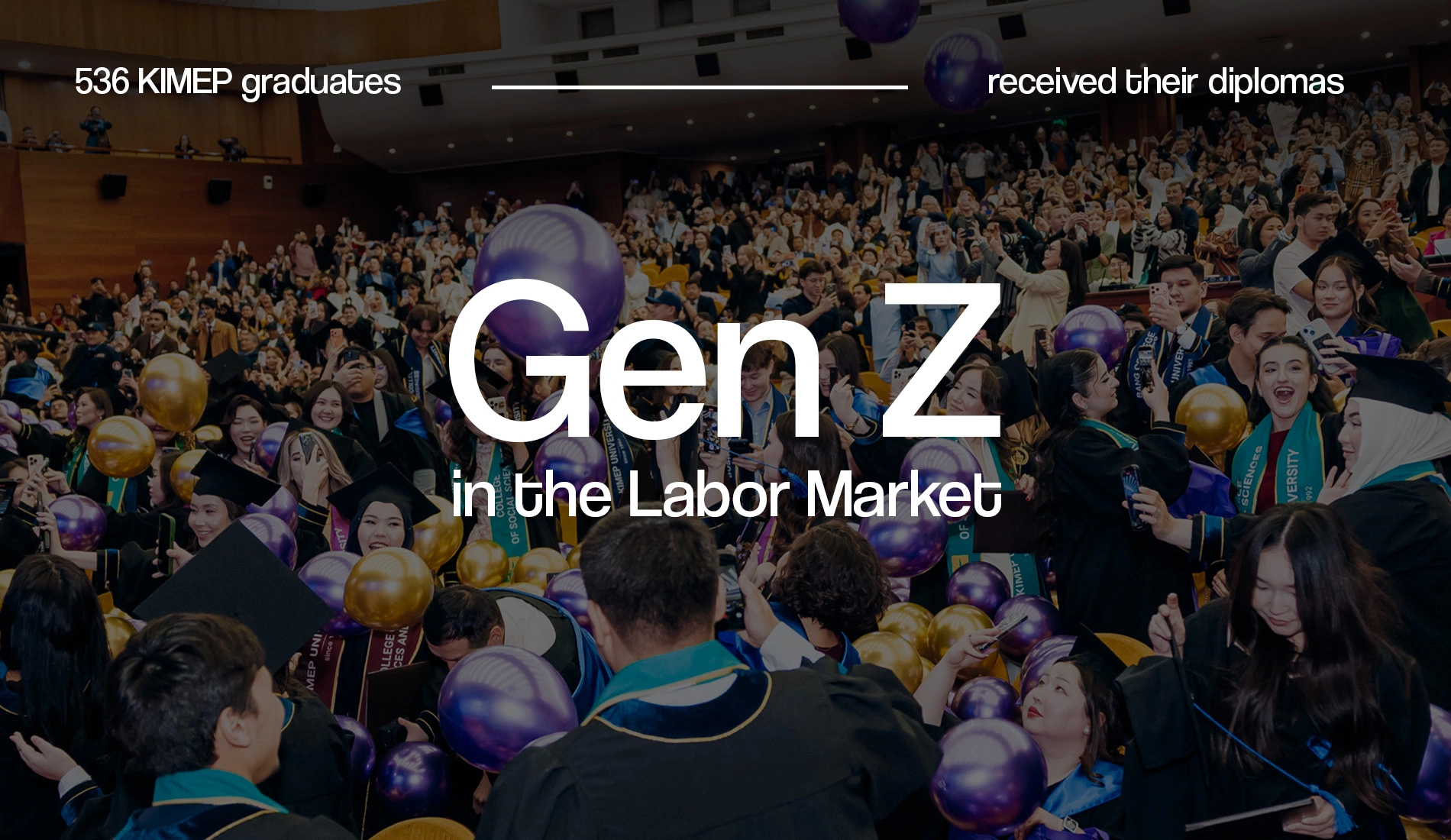
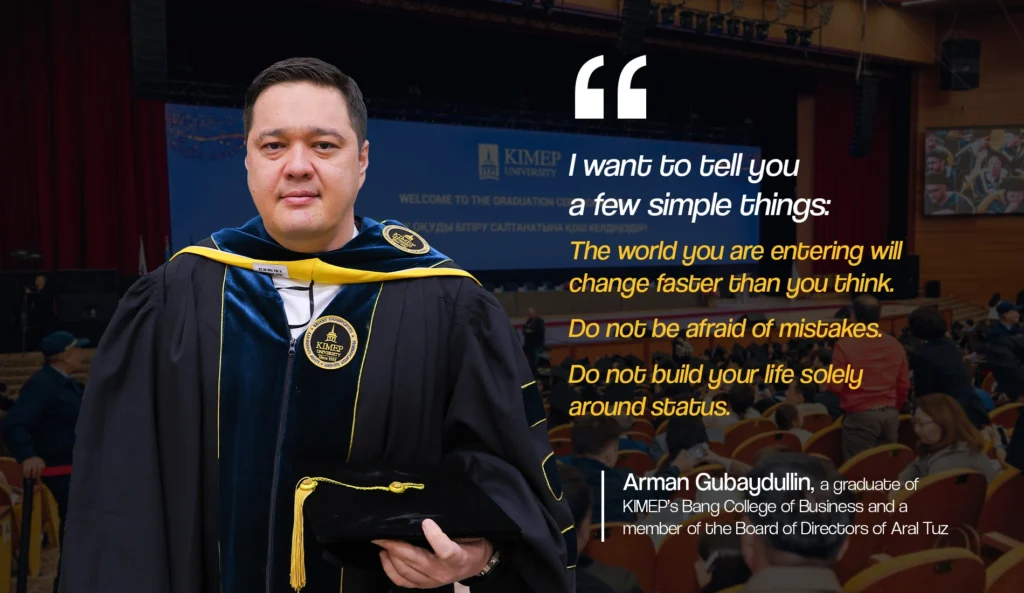
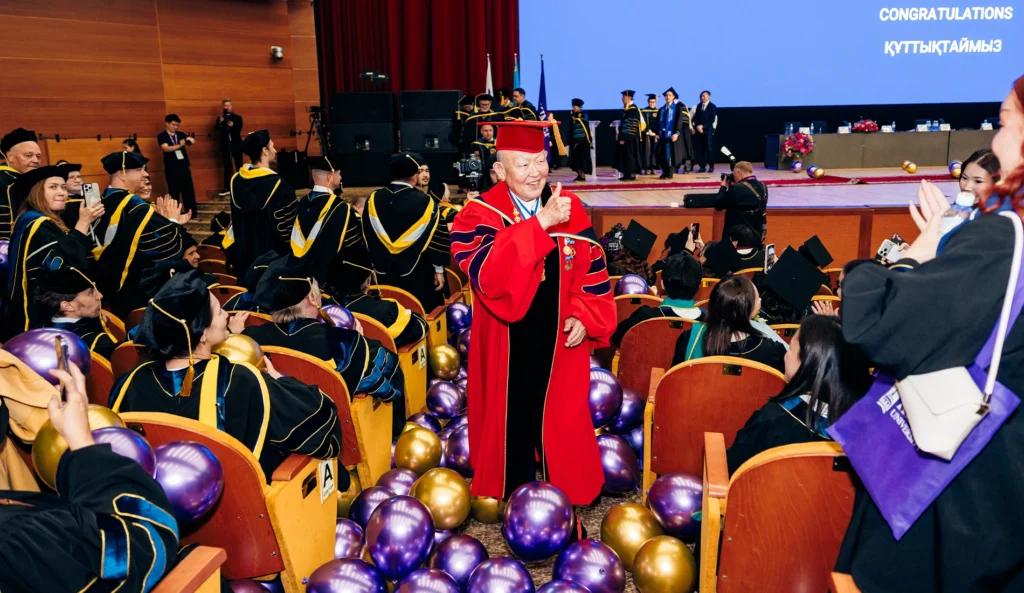
536 KIMEP graduates received their diplomas at the Palace of the Republic, Almaty, and took a step into their professional adult lives. This year’s graduating class represents 13 countries around the world, including Kazakhstan, Tajikistan, Uzbekistan, Russia, Ukraine, Kyrgyzstan, China, Ireland, South Korea, Mongolia, Azerbaijan, the Philippines, and Pakistan. The university administration notes that today’s generation is distinguished by creativity, ambition, and a desire to change the world for the better. Combined with the skills and knowledge acquired at KIMEP, these qualities provide an excellent foundation for adult life. er10.kz reports on the university’s unique educational practices, its students, and the graduation ceremony held on May 23.
Graduates of the Past, Present, and Future
Long gowns, satin sashes, joy, and excitement in their eyes: for KIMEP graduates, a new chapter in life has begun. The years spent studying have borne fruit, and now these happy young people gathered to bid farewell to their student lives and receive their diplomas — the culmination of their academic journey. At the Palace of the Republic, graduates were joined by their families, professors, and, of course, Dr. Chan Young Bang, thanks to whom KIMEP has been providing students with high-quality education, outstanding professors, and broad opportunities for 34 years.
The university’s inclusiveness is also worth noting: the age difference between the youngest and the oldest student is 42 years. This demonstrates that KIMEP makes education accessible to everyone.
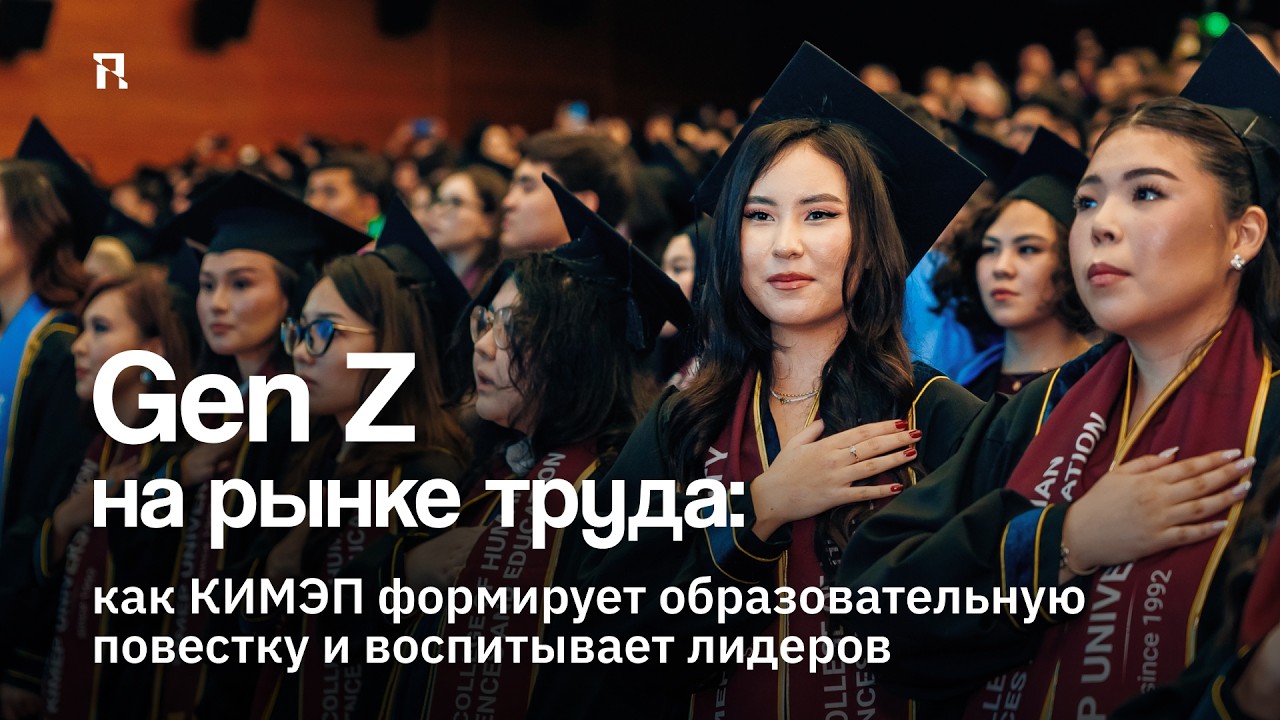
At the beginning of the ceremony, graduates received words of encouragement from Arman Gubaydullin, a graduate of KIMEP’s Bang College of Business and a member of the Board of Directors of Aral Tuz. His professional journey is impressive: 10 years in the oil and gas industry at KMG, Lukoil, and Shell, followed by another 10 years in the mining and metallurgy sector at Kaz Minerals, where he participated in the development of the major industrial projects Bozshakol, Aktogay, and Aktogay 2.
“I want to tell you a few simple things,” Arman Gubaydullin said.
“The world you are entering will change faster than you think. Artificial intelligence, new technologies, and markets are transforming. Many professions will disappear. But there will always be a need for people who can learn quickly and take responsibility. And I am absolutely certain that KIMEP graduates are exactly those kinds of people.
Do not be afraid of mistakes. Almost all great careers are built through failures and moments when nobody believes in you. I have gone through this many times, and so will you. The difference between successful and unsuccessful people lies in discipline and the ability not to give up.
Do not build your life solely around status. Money matters, ambition matters, but over time you will realize that health, family, and reputation are worth more than trying to impress others.”
Arman also shared additional thoughts in an exclusive interview with er10.kz:
“Studying at KIMEP changed my entire life! I was fortunate to study at KTL and then at KIMEP. At that time, the university had the slogan ‘Education to Change Society,’ and it truly had a tremendous impact on both my life and the lives of my friends. We should not forget that your environment shapes your future. Whether you look at the public sector, quasi-government organizations, or business — everywhere you will find KIMEP graduates. And that is a sign of quality.”
According to Arman, the KIMEP alumni community is very close-knit: graduates support one another and organize joint initiatives, and soon a business club will be launched under the Alumni KIMEP network. Alumni are also involved in many charitable efforts. Arman, for example, is one of the founders of the KAEF Endowment Fund for KIMEP alumni. The organization finances education at KIMEP for students who cannot afford tuition themselves.
“It is time to give back to society. We received our education, and now that we have grown professionally, we want to help people who do not have the opportunity to study at KIMEP, because I believe it is the best university in Central Asia.”
Thanks to the fund, 23 students have already been admitted to KIMEP. According to Arman, this inspires him endlessly:
“You know, after a difficult workday, talking to them makes you want to live again. They are all bright and proactive young people. We already have three artificial intelligence startups and many social initiatives. Students who came from remote corners of our country have truly blossomed here. And I am sure that within a year or two, they will make a name for themselves.”
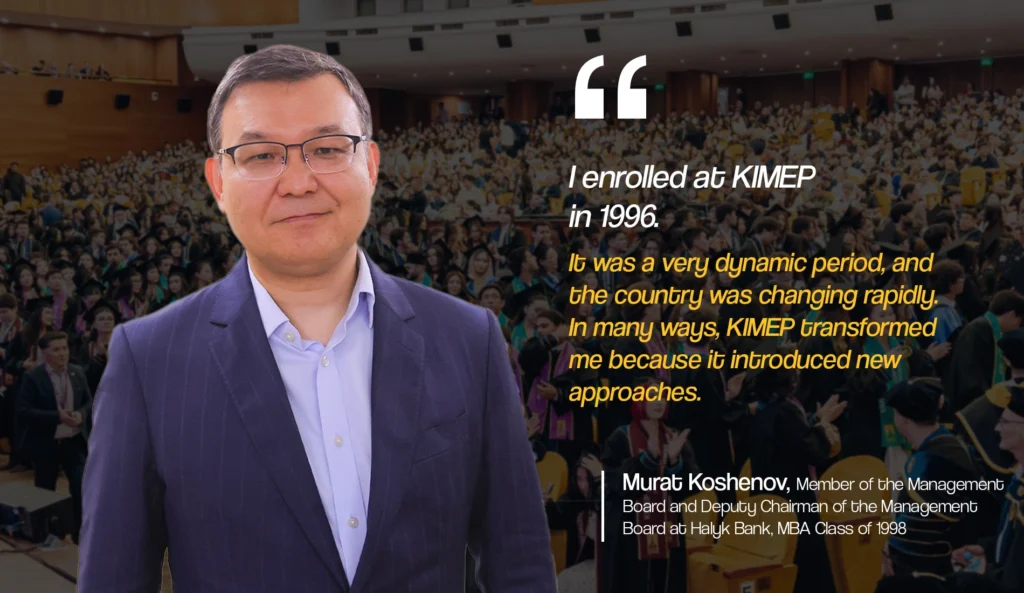
Another KIMEP alumnus, Murat Koshenov — Member of the Management Board and Deputy Chairman of the Management Board at Halyk Bank, MBA Class of 1998 — also spoke about the KIMEP alumni community and its impact on personal development. His entire life is closely connected with the university: he studied there himself, his children studied there, and his wife works there.
“I enrolled at KIMEP in 1996. It was a very dynamic period, and the country was changing rapidly. In many ways, KIMEP transformed me because it introduced new approaches — what is important when building a career, how to approach business, and how to structure processes. And, of course, most importantly, it introduced me to my classmates,” Murat Koshenov shared.
“At that time, KIMEP had a wonderful slogan — ‘The University That Changes Society.’ And indeed, together with KIMEP, society itself was changing, while the university evolved alongside those societal changes.”
Murat noted that throughout its 34 years of operation, the university has consistently maintained leading positions, while its graduates — now numbering more than 15,000 — work across a wide range of industries and professional fields.
“I am happy that KIMEP evolves together with the country, and the contribution of KIMEP graduates has also been significant in the way the country has developed over all these years.”
According to the speaker, the strong demand for KIMEP alumni in the labor market is driven not only by the quality of education and faculty, but also by the continuity between generations and the vibrant student life, where students learn to manage budgets and develop organizational and leadership skills.
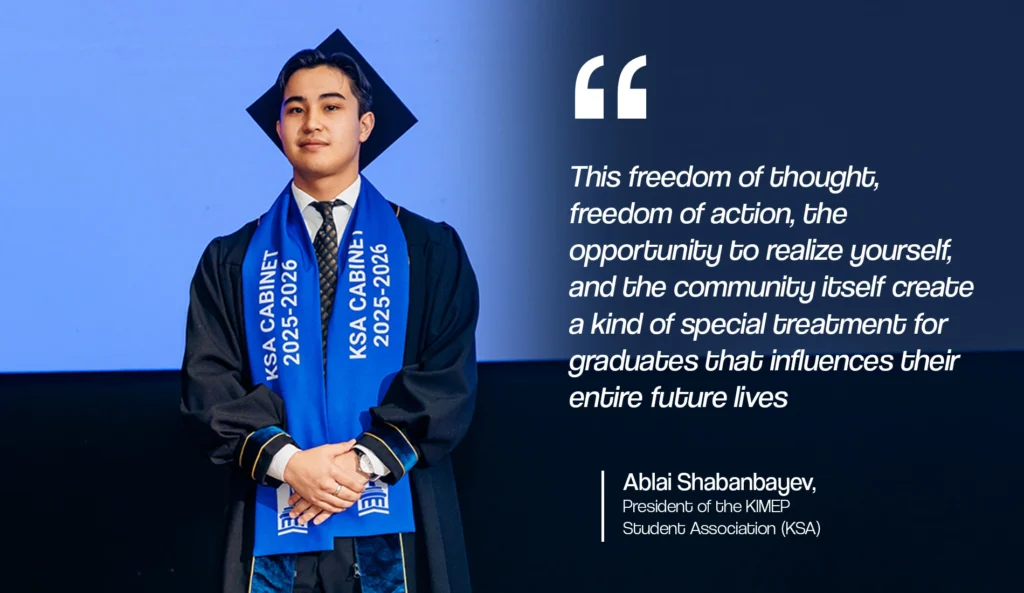
Current graduates and students also agree with the words of older alumni. For example, third-year student Ablai Shabanbayev, President of the KIMEP Student Association (KSA), has already managed to participate in student government, various organizations, and academic activities during his studies. In every sphere, he has been impressed by the freedom given to students.
“KIMEP is truly an amazing place where people with a special type of character come together — people whose energy is simply overflowing. This freedom of thought, freedom of action, the opportunity to realize yourself, and the community itself create a kind of special treatment for graduates that influences their entire future lives.
Our professors are deeply involved in updating educational programs and introducing new teaching methods. At the same time, instructors have long learned how to combine AI tools into the learning process, which increases the effectiveness of both students and faculty members.
During my presidency, I have seen just how ambitious the people studying at our university are. They strive not only academically but also professionally and personally outside the classroom — in ways that will benefit them in the future. They build professional and communication experience. And I am constantly amazed by our students because, despite being so young, they already act like absolute professionals in their fields.”
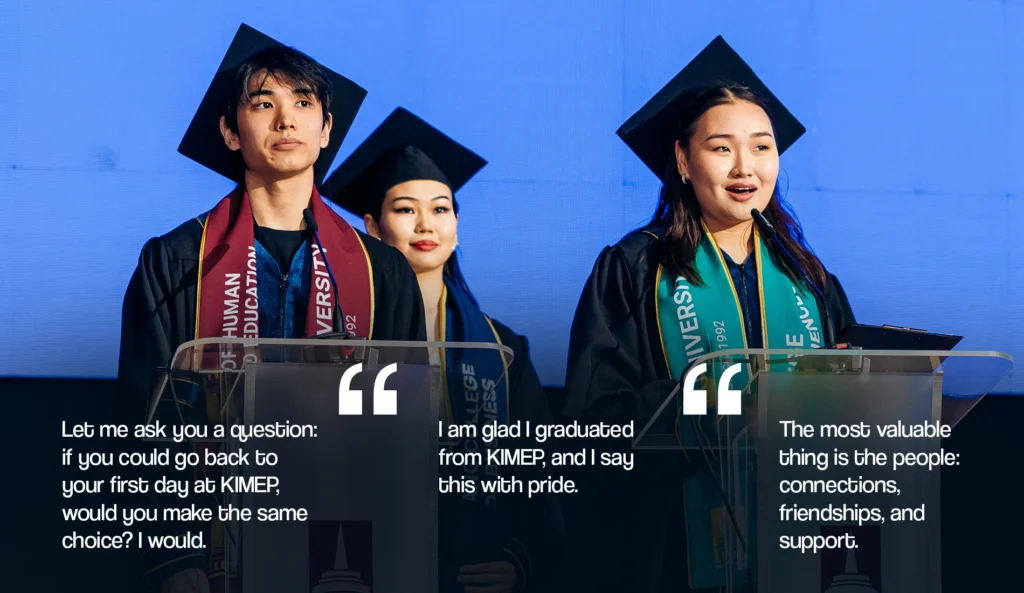
The current graduates also shared their thoughts directly from the stage of the Palace of the Republic:
— Let me ask you a question: if you could go back to your first day at KIMEP, would you make the same choice? I would. And now I know something new: growth does not begin with understanding. It begins with not understanding,” said Venera Medetkhan in English. “When I first came to Kazakhstan, I only knew one Russian word — ‘thank you.’ Once, I stepped on someone’s foot and confidently said: ‘Thank you.’ They looked at me very strangely. Looking back, I realize this was not just an awkward moment. It was the moment when I stopped being just someone who had come here and started becoming someone who has a place here in Kazakhstan. I think this is how the journey began for many of us. We did not fully understand where we were going. We did not fully understand what it would require. But we kept going. And at some point, everything changed. For me, that moment was speaking on stage in Europe, where I represented KIMEP at an international case competition and felt confident. That is when I realized what KIMEP does: it changes people.
“I am glad I graduated from KIMEP, and I say this with pride. Over these years, we gained not only knowledge but also valuable experience. This experience gives us the courage to move forward,” noted Ayaulum Kozhatai in Kazakh.
— I would like to begin today’s speech with a quote from Haruki Murakami. In his novel “Kafka on the Shore”, he wrote: “And once the storm is over, you won’t remember how you made it through, how you managed to survive. You won’t even be sure whether the storm is really over. But one thing is certain: when you come out of the storm, you will no longer be the same person who walked into it. That is what this storm was about.” And I think these words are about us. Each of us has gone through our own trials. For many of us, these were exams, tests, projects. But every time we managed — sometimes thanks to preparation, and sometimes thanks to a sleepless night before the exam,” shared Islam Gabdulkayum in Russian. But it is not only about studies. The most valuable thing is the people: connections, friendships, and support. I sincerely value every person I met over these four years, because it was these people who made this journey truly unforgettable. And today we stand here on the threshold of a new life. And the truth is that no one knows what will happen tomorrow, in an hour, in a minute, or even in a second. And that is the beauty of life. Because, as they say, we live every day, even though we die only once. And every day is a chance — a chance to become better, to try, to make mistakes, and to move forward again. And yes, we will be afraid. But fear should not be an obstacle. Fear is a point of growth. If we have already gone through everything we have experienced here, then we are ready for what lies ahead. Dear graduates! Our future begins today.
Education that Sets Trends
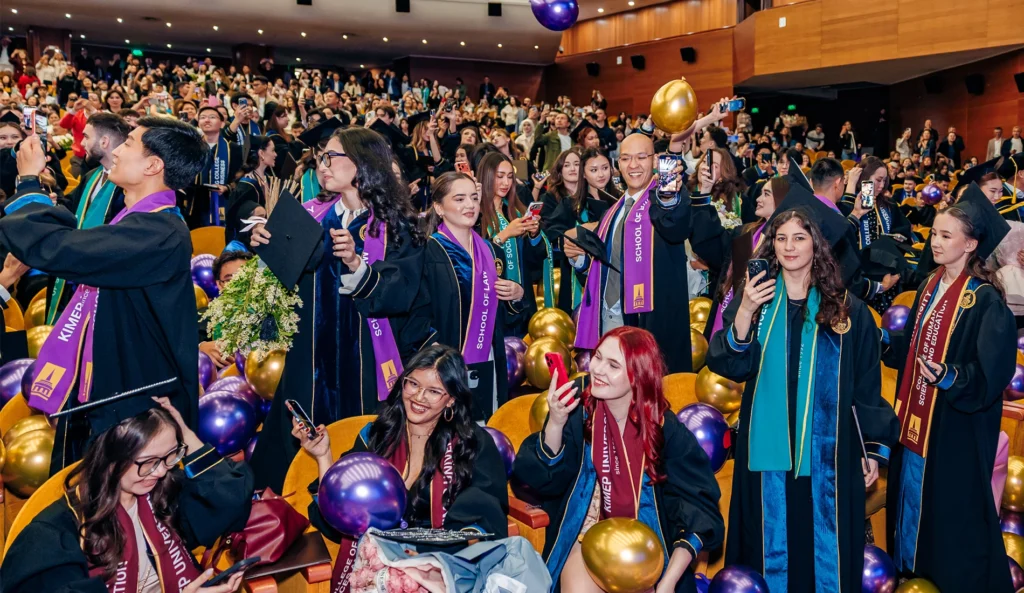
The future truly began at the very moment when, stepping onto the stage to applause, yesterday’s students became qualified professionals. Entire families watched the ceremonial awarding of diplomas: some came with all their relatives, some were supported by friends, and some even received their long-awaited diploma with their own baby in their arms. We asked the graduates what this day means to them:
— I have become much more confident, because before entering KIMEP I was a completely different person. I gained many friends, as well as willpower and discipline,” shared Akdana Zhamalbek, Accounting and Auditing. “But the most important thing I learned is to always be myself and never adjust to other people. Life is long, and you need to trust yourself. I have already worked for about six months at Deloitte, Big Four, in my field, and now I want to try myself in new directions, such as finance.
— Today marks the graduation of the first cohort from the Psychology Department,” said Islam Gabdulkayum. “In Kazakhstan as a whole, this is the only department that teaches psychology in English. I consider it a good path of development. Initially, I wanted to enroll in a basic specialty, bioengineering, but then I accidentally entered KIMEP for psychology, and I am glad about that decision. The most important thing I gained is connections and friends. Within the next year, I plan to pursue a master’s degree abroad.
— I am a different person now compared to four years ago,” said Mizhun Timurov, Business Information Systems, Tajikistan. “Different people and challenges have made me more confident, stronger, more flexible, and smarter. My future plan is to pursue a master’s degree, but I would like to work in the field of AI. KIMEP offers many opportunities, and you need to make use of all of them: there are exchange programs, guest lectures, and talks by successful people.
— My mother recommended that I enroll in KIMEP, and it had the best possible impact on my personality: communication skills are developed here, there are many student organizations, and the students are all very open,” said Daria Varchenko, International Relations. “The key lesson I learned at KIMEP is: if you are confident in yourself, everything will work out. — KIMEP, like many universities, taught me to enjoy my time, study well, and take everything life has to offer,” admitted Azamat Duisenali. “I plan to start my career in an international company in the future.
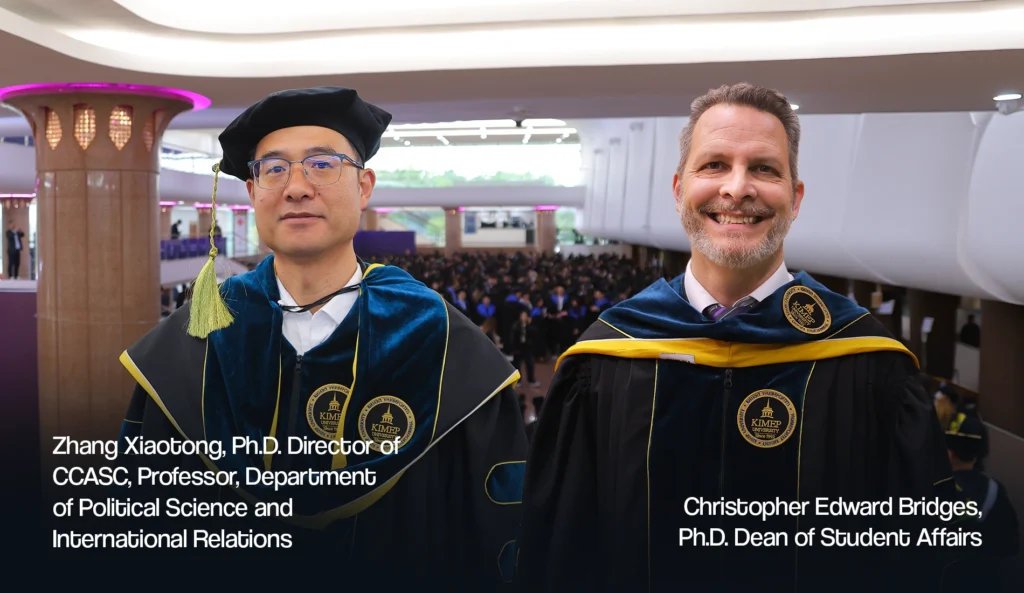
What professors think about the educational process at KIMEP, we learned directly from them:
— I believe that students who come to KIMEP receive a unique opportunity to develop as well-rounded individuals. We prepare those whom we consider future leaders of Kazakhstan and Central Asia. In my view, this is exactly what a KIMEP graduate should be. Today, every student should leave here not only with a strong education but also with the skills and abilities that will help them lead and build the future,” shared Christopher Edward Bridges, Ph.D., Dean of Student Affairs. “My home country is the United States, and it is undoubtedly a leader in many fields. But what is especially impressive now is the level of investment Kazakhstan is making in education — both from the state and from private organizations such as KIMEP. This is a country that views education as a pathway to the future. And KIMEP plays an important role in this. We are talking about more than 30 years of implementing a Western model of education adapted to local context, skills, and advantages. I believe Kazakhstan is currently at a very strong stage of development. That is partly why I am here — because I see how the country supports higher education. And I am proud to be part of this process.
— I believe KIMEP teaches students to be open, inclusive, and to engage in dialogue with the whole world. It is truly an international university: we have a multinational faculty and student community. This creates real intercultural exchange between students and professors,” said Zhang Xiaotong, Ph.D., Director of CCASC, Professor in the Department of Political Science and International Relations. “Perhaps the most important life lesson we can pass on to students is to remain open-minded, act with confidence, and strive for peace and prosperity.
Zhang Xiaotong noted that he is originally from China, where most universities are large multidisciplinary research institutions: “I see that KIMEP is gradually transitioning from a predominantly teaching-oriented model to a research university. The same is happening in other universities in Kazakhstan. Faculty members are increasingly encouraged to engage in research activities and publish in top journals. At the same time, teaching students remains our top priority. I believe KIMEP’s core mission is a student-first approach, where the student is at the center. But we also understand that teaching and research are closely connected. Research supports teaching, and teaching supports research. I am truly inspired by my students — their questions and presentations on business diplomacy, multinational corporations, and geopolitical risks. As a former diplomat, I share with students my experience of how diplomats work in conditions of crisis and geopolitical tension. In return, students present their own ideas through presentations and assignments. So teaching and research are two sides of the same coin. And I really enjoy this process.”
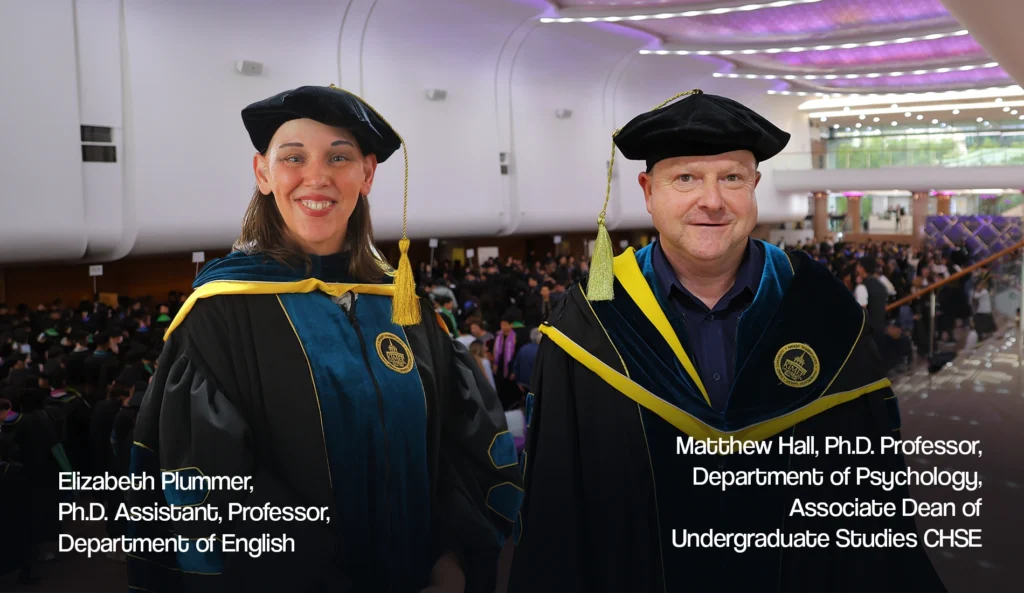
— KIMEP instills self-organization, hard work, ethics, and much more. Students here are educated according to international quality standards,” said Matthew Hall, Ph.D., Professor in the Department of Psychology and Associate Dean of Undergraduate Studies at CHSE. “Therefore, whether they receive their diploma here or in my home country, the United Kingdom, the standards are equally high — at least, we carefully ensure this in the Department of Psychology.
— KIMEP is truly a remarkable place for preparing graduates for life and work in a global society,” concluded Elizabeth Plummer, Ph.D., Assistant Professor in the Department of English. “Here, very diverse people study, so students gain experience interacting with representatives of different countries and cultures. In addition, we teach basic skills necessary for success regardless of the major. We provide students with a lot of practical experience, internship opportunities, and study-abroad programs, helping them adapt to a constantly changing world.
Being originally from the United States, Elizabeth reflected on KIMEP’s educational system: “KIMEP largely uses the foundations of the American educational system in its structure. I think this is what makes the university special compared to other institutions I have worked with in Kazakhstan. And I believe such diversity of educational approaches is wonderful, because students can choose the learning format that best fits their needs and future goals.”
New Technologies and New Opportunities
KIMEP teaches students from an early age to value every opportunity they receive in life and to manage them wisely. Having the art of networking and the ability to learn, to make oneself heard in the world, and never to lose faith in oneself — these are among many things students gain at this university alongside their core academic program. In addition, they study modern technologies integrated by professors into different disciplines. The faculty explained how this is implemented:
Elizabeth Plummer, Ph.D., Assistant Professor, Department of English: “I specialize in computer-assisted technologies in language learning, so I actively use technology in a meaningful and purposeful way. I select tools that best help students develop English language skills and international communication. I use a wide range of technologies — not only AI, but also virtual and augmented reality, as well as cloud-based services that have been used for many years.”
Matthew Hall, Ph.D., Professor, Department of Psychology, Associate Dean of Undergraduate Studies CHSE: “The learning is very interactive, and this is what, in my view, makes KIMEP stand out.”
Zhang Xiaotong, Ph.D., Director of CCASC, Professor, Department of Political Science and International Relations: “KIMEP is open to the use of AI, and we encourage students to engage with these technologies constructively. Faculty members also actively use AI in teaching and pedagogy. We understand that AI is a new and rapidly developing field, so we continue to learn ourselves while also helping students master it. KIMEP also organizes various training sessions for faculty to develop skills in working with AI and modern technologies.”
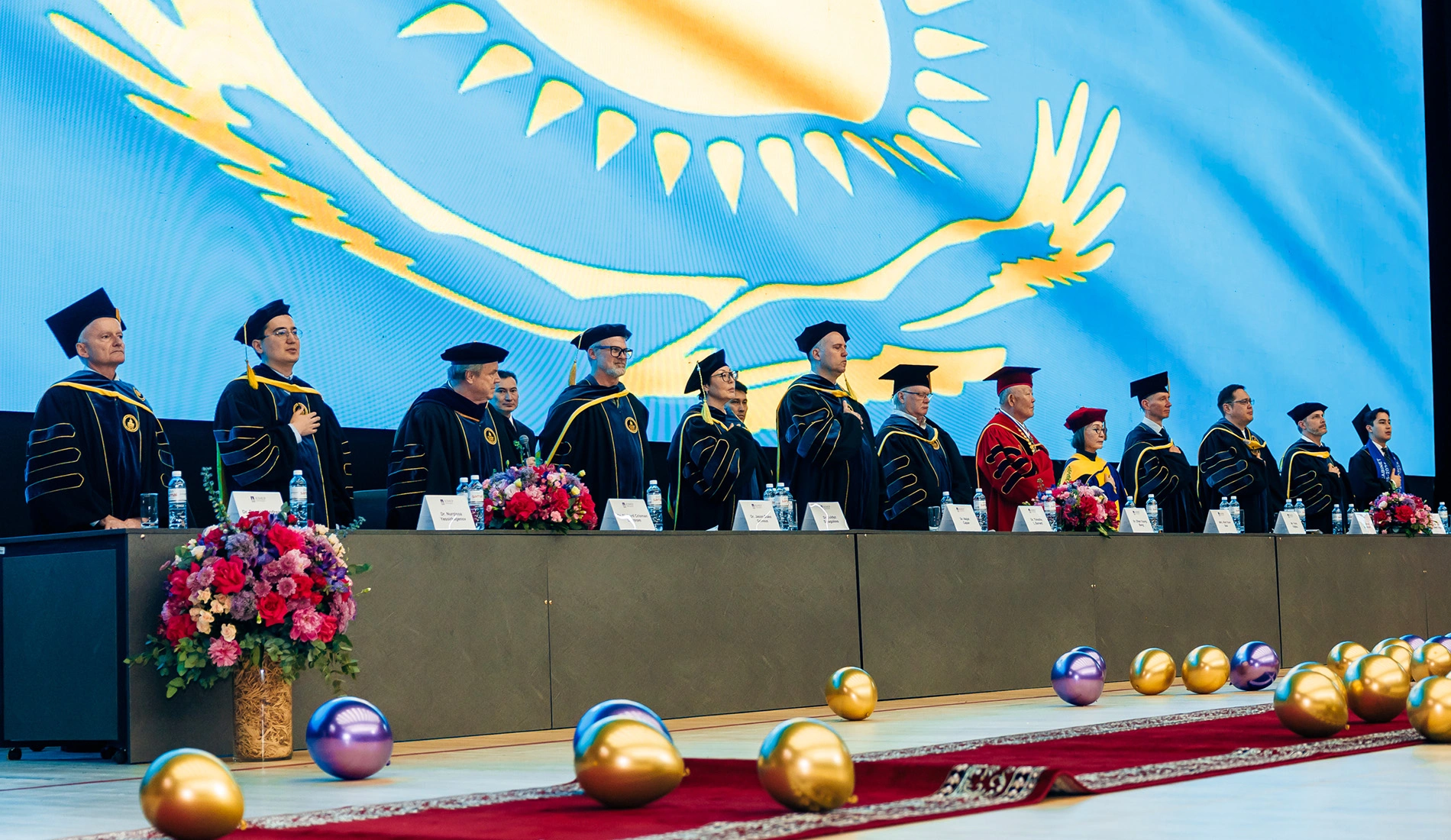
Christopher Edward Bridges, Ph.D., Dean of Student Affairs: "AI has been a major step forward, much like the calculator once was. It is a tool. And I believe that when used properly, it delivers excellent results. I have had the opportunity to work with AI together with master’s students — responsibly and thoughtfully. We explore together how to use this tool to support our work, as well as how to critically evaluate it. When does it make mistakes? How can we recognize that? I believe AI will be part of every graduate’s life. We already know this — they are already using it. Therefore, it is important to help students learn how to apply it in a way that helps them achieve their future goals".
And for the graduating students, the challenge will be to apply in life not only artificial intelligence, but all the knowledge and skills they have gained throughout their studies. And although their path may sometimes be uneven or difficult, we know for certain: they will overcome all challenges with dignity, proudly carrying the title of KIMEP Alumni and upholding the principles of their alma mater throughout their lives.