

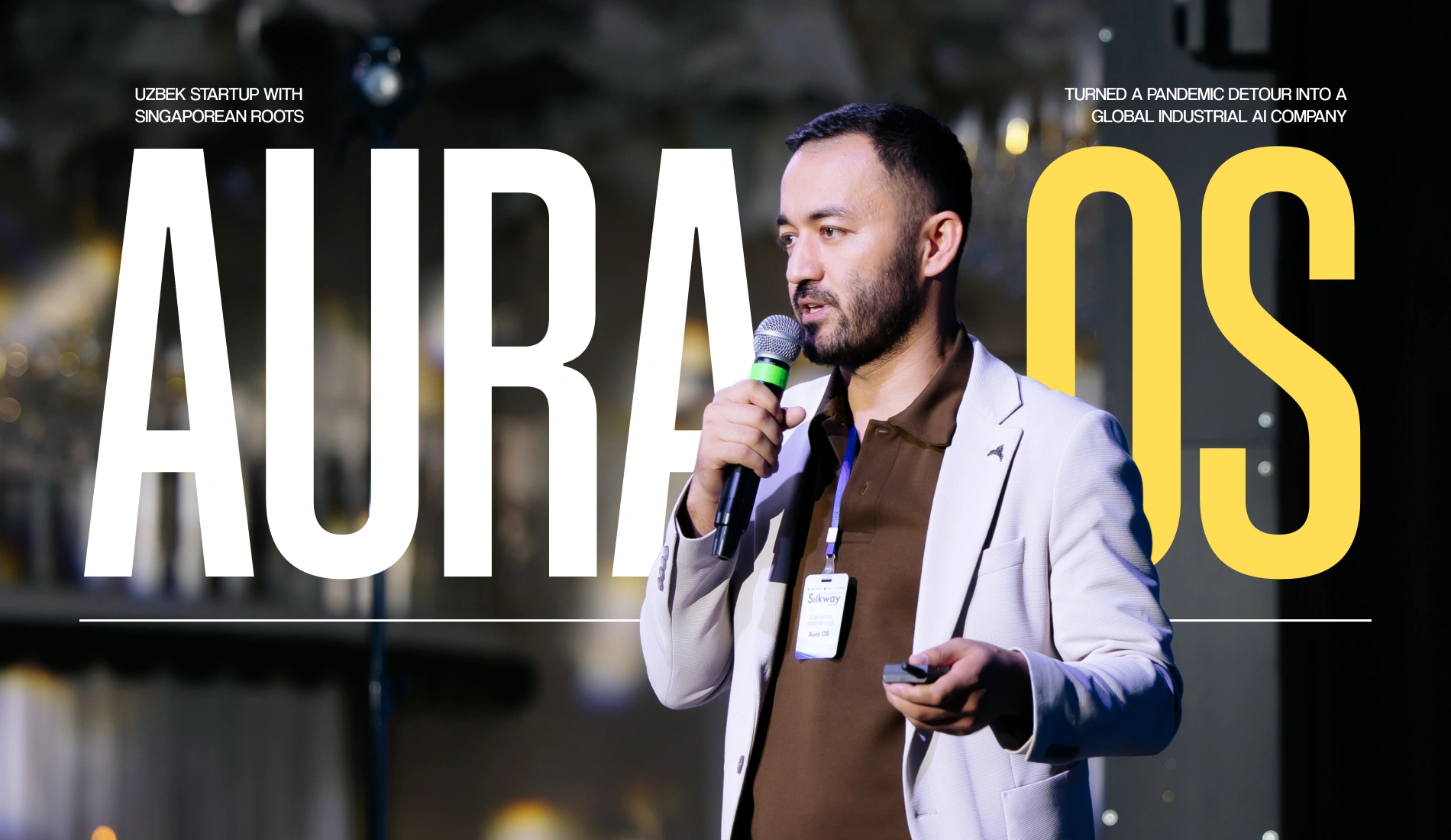
Zukhriddin Nuriddinov, founder of AI startup AURA OS, is an Uzbek entrepreneur with business-roots in Singapore. Unlike traditional ERP systems that report problems after the damage is done, AURA OS monitors a factory in real time and tells manufacturers how to fix production bottlenecks before they cost money. In an exclusive interview with Central Asian business media er10.kz Zukhriddin explained how his AI technology works — and addressed how sanctions are shaping his expansion plans between the US and China, without taking a controversial stance.
AURA OS combines an integrated ERP foundation with an AI-native operational intelligence layer within the same platform. It connects operational information across procurement, production, inventory, sales, finance and management, then helps detect problems, predict what may happen next, quantify potential financial impact, recommend action, assign responsibility and track the issue until it is resolved.
— How did you come up with the idea of your startup?
— AURA OS did not start as an AI company. It started with a problem inside a textile factory.
The story goes back to Singapore around 2018–2019. My business roots are there. Before AURA OS, I co-founded a fintech company with my partner, James Anderson, who is from the UK. I graduated from Cardiff Metropolitan University through its Malaysia-based programme, and after graduation James and I started our company in Southeast Asia. We were providing asset-management and fintech products and systems for banks.
Then the pandemic happened. I had to return to Uzbekistan for a personal family reason, but I continued running the Singapore business remotely. I started recruiting engineers locally, and we continued delivering projects.
During that period, friends in my network were connected to the textile industry. One evening, over dinner, a friend who owned a textile company told me he had been looking for a system like this from Turkey or other countries. I didn't want to sell him something before understanding the problem, so I took my team to the factory.
We followed the process from raw materials all the way to finished goods and looked at where problems were actually happening. That became our approach: understand the operational problem first, then build the technology around it.
For the next one to two years, we treated these engagements as projects — part consulting, part technology. Eventually we realized that many manufacturers were facing the same problems. So instead of solving the same problem company by company, we turned what we had learned into a product.
AURA OS was announced as a product in 2023. So the story is really: we understood the problem first, built an MVP around a real customer problem, and only then turned it into a scalable product.
— What are the problems that are relevant to Central Asia that you can solve?
— When we started working with companies in Uzbekistan, Kazakhstan, Tajikistan, Kyrgyzstan and other regional markets, many enterprises wanted one system to cover the whole operational process — raw materials, purchasing, production planning, inventory, sales, cashier operations, finance and management.
But after going deeper, I realized that the biggest problem was not simply the absence of another software module. There were several operational problems that were costing companies money.
The first is production bottlenecks and delayed orders. A manufacturer can have a large order from an overseas customer, but one bottleneck somewhere in production can slow down the entire order.
The second is what happens when a seasonal order is delayed. If the product arrives after the customer's selling season, the customer may not be able to sell it at the original price. They may ask the manufacturer to hold the goods until the next season, negotiate a discount, or decide not to take the goods. Then the manufacturer has finished goods sitting in a warehouse, cash tied up in inventory, and pressure on working capital. In serious situations, that pressure can eventually affect the company's ability to pay suppliers or employees on time.
A third problem is delayed customer payments. The manufacturer may have delivered the product but still be waiting for cash, while at the same time it needs money for the next raw-material purchase, payroll and ongoing production.
We have also seen companies use personal networks or external partners to finance production cycles. Someone provides money for a production cycle expecting a return when the customer pays. But if the customer's payment is delayed, or the money gets absorbed by operating expenses, the expected cash cycle becomes difficult.
Raw-material purchasing is another issue. When cash is tight, a company may delay purchasing and production slows down. In other cases, a company buys too much because it doesn't have enough visibility into demand. So you can have a shortage of one material and excess inventory of another at the same time.
There is also a make-versus-buy problem in manufacturing clusters. Sometimes a company produces a component internally even though outsourcing it could be faster, cheaper or better quality. In other situations outsourcing introduces delays or quality risks. The real question is which part of the production chain should stay inside the company, and which part should be outsourced.
But underneath all of these problems, we found an even deeper issue: management often doesn't have the right data in real time.
In many factories, finance teams still have to collect information from different departments, sometimes from handwritten documents and spreadsheets, consolidate it, calculate costs and prepare reports. The accountant may be doing everything correctly, but by the time the report is ready, the factory has already moved on.
Even calculating the real cost of one unit can be complicated. You need to understand raw materials, employee attendance, machine performance, production time, outsourcing, depreciation or lifecycle costs, equipment rental, facility costs and other overhead. Planned cost can also diverge from reality because an employee was absent, a machine stopped, material prices changed or production had to be outsourced.
So a financial report can be accurate and still arrive too late to prevent the loss.
That is what we are trying to change. AURA OS brings operational information together continuously so management can see what is going wrong, why it is happening, what it could cost, what is likely to happen next and what action should be taken while there is still time to change the outcome.
— We can say that now companies are faster — they don't need more human resources, because they have your AI, right?
— I wouldn't say AI simply replaces human resources. The better way to describe it is that AI helps a company get more output from the people, machines and resources it already has.
For a manufacturer, the objective is not to remove people. It is to reduce manual analysis and coordination, identify where capacity is being lost, and help people make better decisions faster.
For example, if a production line has three stations and one is producing 100 units, the next is producing 50, and the third can produce 100, the whole line is constrained by the middle station. Adding more capacity to the first or third station doesn't solve the problem.
AURA OS can identify that bottleneck and help management consider actions such as moving or retraining workers, reallocating tasks, changing the production sequence or outsourcing a particular stage when it makes economic sense.
We have seen cases where this type of optimization increased production output by approximately 2.1 times without requiring a proportional increase in machinery or headcount. The important point is that this can be the difference between buying more capacity and understanding the capacity you already have.
So the idea is not 'AI instead of people.' It is better intelligence for the people running the business.
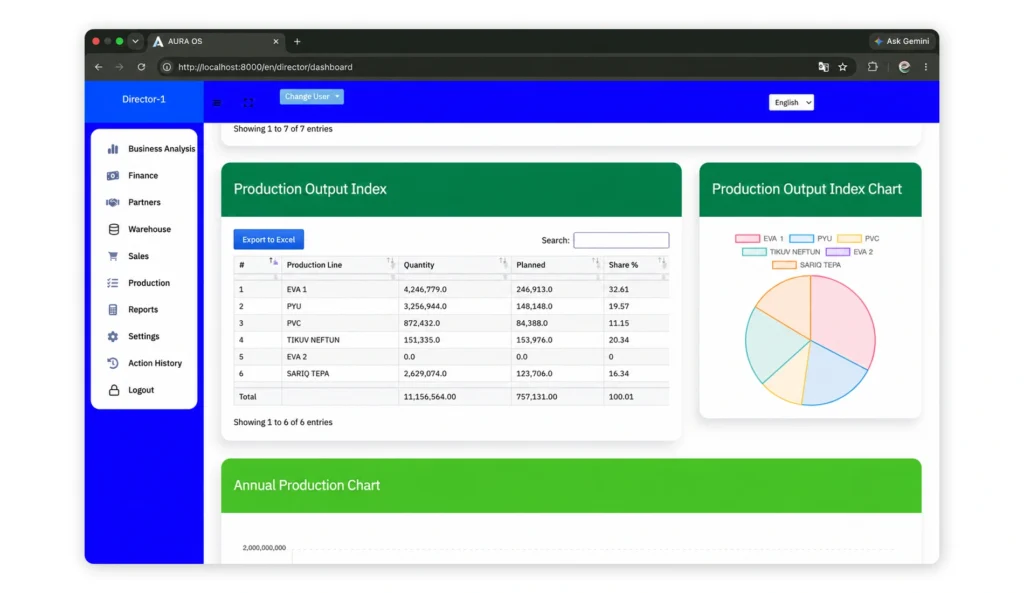
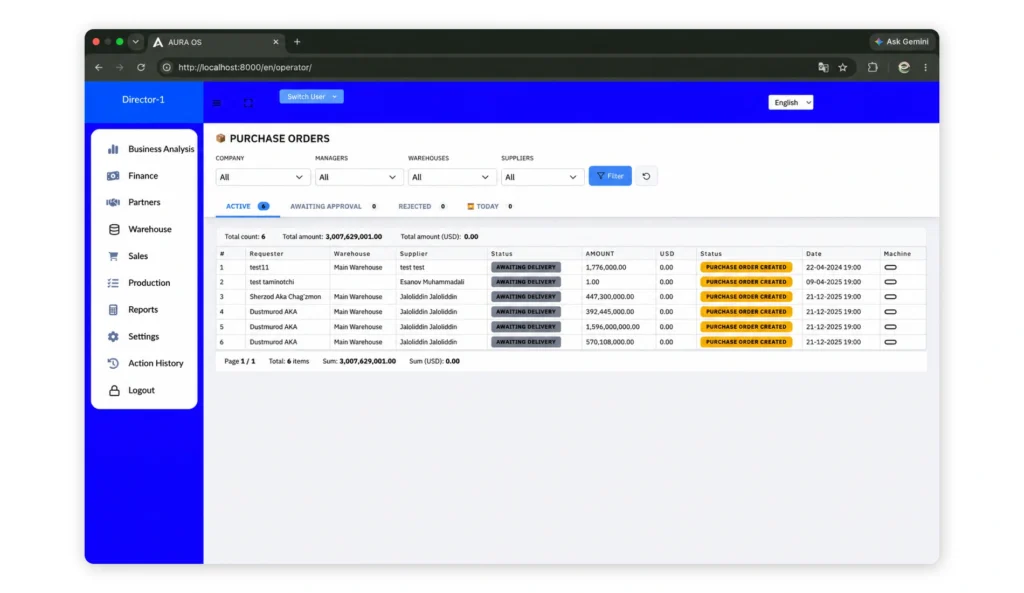
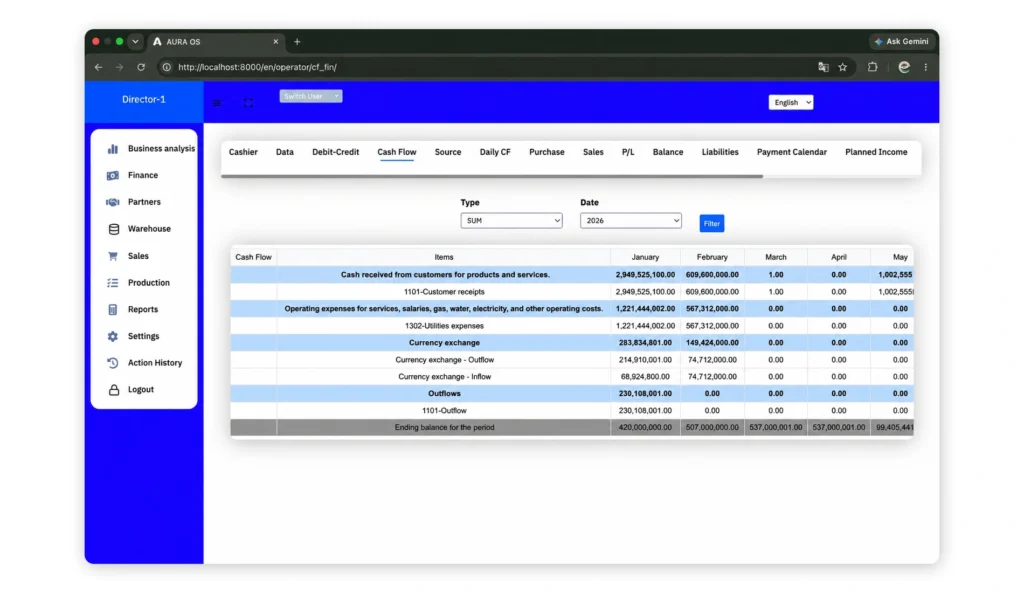
— Could you explain how exactly your technology works, and how exactly your AI works?
— The easiest way to explain it is through the operational loop.
First, AURA OS collects and connects operational data across the business. That can include procurement and raw materials, production, inventory, sales and orders, finance, workforce information and management activities.
Then the system continuously analyzes that information.
It can detect an emerging problem, predict what may happen next, estimate the operational and potential financial impact, recommend what management should investigate or do, assign the action to the responsible person, and then track whether the action was actually completed.
So the loop is: real-time data → detect → predict → quantify financial impact → recommend action → assign → track → done.
For example, imagine a manufacturer receives a large order. Current production capacity, workforce availability, machine utilization, raw materials and schedule may indicate that the order is likely to be delayed. Instead of waiting for a month-end report, AURA OS can identify the risk earlier, estimate the potential impact and recommend actions such as reallocating capacity, changing the production schedule, purchasing additional material or outsourcing a specific stage.
The same applies to raw materials. If the system sees that a production plan could consume a material faster than it is being replenished, it can warn the responsible person before the shortage stops production.
And importantly, the process does not end with the warning. The issue can remain open as a task until the responsible person takes the action and it is marked as done.
Traditional ERP systems are important because they provide the operational foundation of a business — sales, inventory, procurement, production, finance and other core processes. AURA OS combines these capabilities with AI-native intelligence within the same platform. We see that as Operational Intelligence for industrial companies: not simply recording what happened, but continuously helping management understand what is happening, what is likely to happen next, what it could cost and what to do about it.
So we are not simply recording what happened. We are trying to help management understand what is happening, what is likely to happen next, what it could cost and what to do about it.
— Could you also explain the technology in terms of cybersecurity? Some people are afraid of AI startups, because they think the AI will be learning from their personal data, and that it won't be safe. What would you say to that?
— Enterprise AI is different from using a public consumer chatbot with sensitive information.
AURA OS is designed around enterprise requirements and the client's data environment. We don't believe a manufacturer should have to give up control of its operational data simply to benefit from AI.
For clients with strict security, regulatory or data-residency requirements, the system can be deployed within the client's own infrastructure or through a dedicated environment, depending on their requirements. We can apply appropriate access controls, encryption and other security measures around sensitive operational and financial information.
Data residency is also important because requirements differ by country and industry. Where a client needs certain information to remain within a specific jurisdiction, the architecture can be designed around applicable requirements.
My background in fintech influenced this strongly. Financial institutions deal with sensitive information and strict controls, so we learned early that security cannot be something you add at the end of a project. It has to be part of the architecture from the beginning.
Ultimately, the exact architecture depends on the client, its infrastructure, its industry and applicable regulations. Our objective is to give companies the benefits of AI while allowing them to maintain the level of control, security and compliance their business requires.
— So, it depends on whether the client wants this or that?
Exactly. Enterprise customers have different infrastructure, regulatory and operational requirements, so AURA OS is designed to be configurable around those requirements rather than forcing every company into exactly the same environment.
— If I'm a client and I want to work with AURA OS, what should I do — step by step?
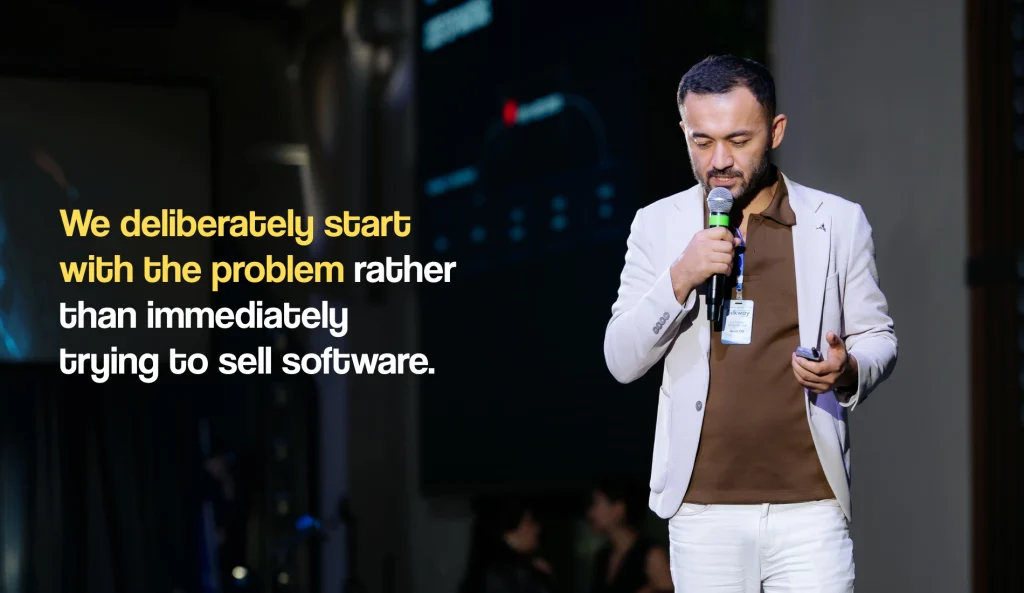
— We deliberately start with the problem rather than immediately trying to sell software.
The first step is to collect information about the company and its operational situation. We have developed an AI-driven audit process that helps us collect and structure this information quickly.
The audit has two purposes. First, it helps us determine whether the company is actually a good fit. We don't want to take every company as a client if we don't believe we can create meaningful value.
Second, it helps the company understand where its biggest operational and financial opportunities may be. The audit can identify areas such as production bottlenecks, inventory problems, working-capital pressure, delayed orders and potential margin leakage.
If the company qualifies and decides to move forward, we connect the relevant operational data and configure the platform around its needs.
Then we generate the operational intelligence, train the relevant employees, go live and provide ongoing support.
So the process is: business information → AI-driven audit → qualification → onboarding and data connection → operational intelligence → training → go-live → ongoing support.
We are deliberately making this repeatable. We don't want every customer to become a six-month customization project.
— What are the exact functions I get as a client, and then, day to day, how does it actually work?
— AURA OS is modular, so a company does not necessarily have to implement everything at once. We start with the operational problems that matter most.
For a typical manufacturing company, the platform can cover raw materials and procurement, production planning and operations, warehouse and finished goods, sales and orders, finance and working capital, and management control. There are also different user roles and access levels.
But the value is not simply having all those modules. The value is that the information works together.
Imagine you have a large customer order. AURA OS can look at the order against current production capacity, raw materials, workforce, machinery and the production schedule. If capacity is not sufficient, the system can raise an alert about a likely delay, show the potential impact and recommend what to investigate or change.
Or imagine a raw-material shortage is likely in 14 days. Instead of discovering the shortage when production stops, procurement gets an early warning and a recommended action.
The same applies to inventory and sales. If finished goods are accumulating, an order is moving too slowly, or a product is tying up too much working capital, the system can identify the situation and bring it to the responsible person's attention.
There is also a management and audit layer that keeps a history of important changes — who changed something, when it was changed and what the previous value was.
Most importantly, the action does not stop at the alert. The issue becomes an actionable task with a responsible person and can remain open until it is resolved.
That is how we want AURA OS to work day to day: not another dashboard with hundreds of numbers, but a system that continuously helps answer: What is happening? What is going wrong? What is likely to happen next? What could it cost us? What should we do about it? And has the action actually been completed?
— After the system has been set up, is there a period during which we can ask you questions about how it works — or if we run into difficulties, can we just reach out to you? Or is there no such period?
— Yes. Support is part of how we deliver AURA OS.
We learned from earlier experience that if every question has to be handled manually by our team, it becomes difficult to scale while maintaining a good customer experience. So we built an AI-driven support process around the product.
After implementation and training, clients can ask questions through the AURA OS AI chat. It can provide immediate guidance on using the system and help with common technical or operational questions.
If the AI cannot resolve the issue, the client can escalate it to our technical support team.
Under our standard enterprise agreements, technical support is provided for 12 months after the contract is signed. The goal is simple: the client should not feel left alone after go-live. There should be an immediate way to get an answer and a clear path to human technical support when necessary.
— Could you please tell us more about your team members and about your own background?
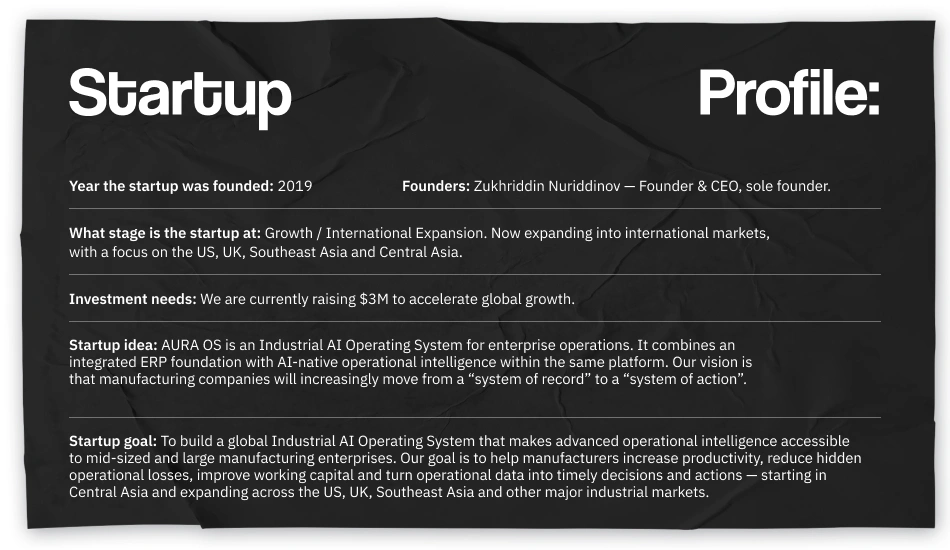
— I'm the founder and CEO of AURA OS. I am the sole founder of AURA OS, although before AURA OS I built a fintech business with my partner, James Anderson.
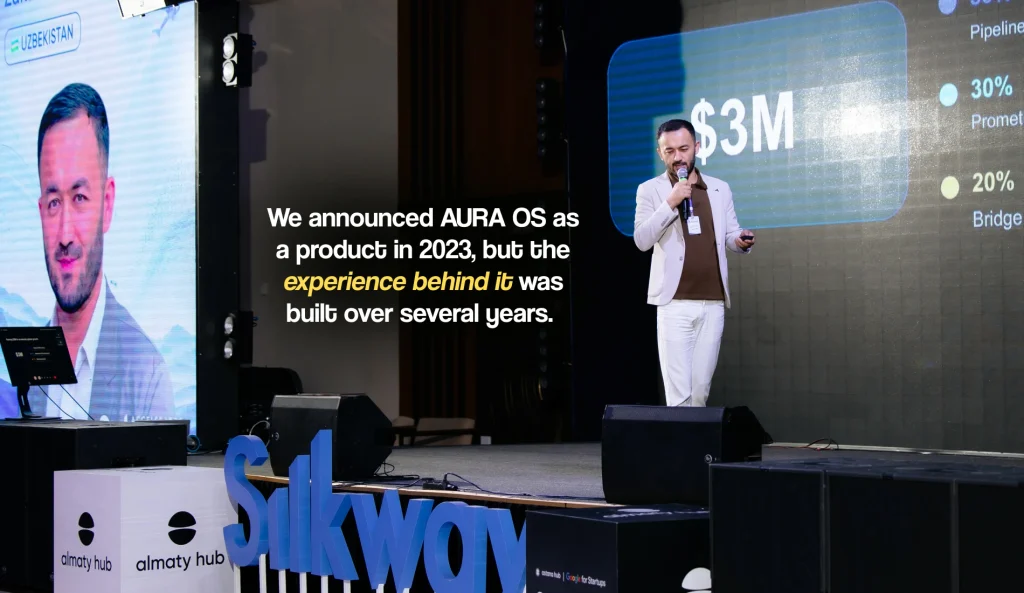
We announced AURA OS as a product in 2023, but the experience behind it was built over several years. Before becoming a product company, we delivered close to 20 technology projects across HR, CRM, retail and distribution. Historically, we served around 500 businesses.
Today, the focus is much more specific: manufacturing. Around 80 manufacturing companies are active AURA OS clients.
We have been 100% bootstrapped to date. I also have a CTO and an engineering and product team focused specifically on AURA OS.
In 2019–2020, through Algorithm Gateway, our project-based technology business, we had more than 100 full-time employees. As the company moved from project work into a product company, we streamlined the organization and concentrated the team around AURA OS and scalability. Today, around 20 people work directly on AURA OS.
We also have people with backgrounds in major accounting and consulting firms, including professionals with around ten years of experience in finance and business operations. At the management level, we have directors based in Malaysia and managing directors based in Singapore supporting the international side.
The majority of our operational team is now in Uzbekistan, where we have our strongest manufacturing customer base and product development operations, while part of the team remains in Singapore.
So we are a much leaner team than the project business we had historically, but much more focused around one product and one global mission.
— So is the startup based in Singapore, or in Uzbekistan?
— The company has roots in Singapore, and Singapore remains an important part of our international structure and business history. But AURA OS was validated and developed through our work with manufacturing companies in Central Asia, especially Uzbekistan.
The simplest way I describe it is: AURA OS started in Singapore, was validated in Central Asia, and is now expanding into global markets.
— So how did you decide which country to expand to first? Why did you decide to start growing your startup in Uzbekistan first, and not the US?
— Initially, starting in Central Asia wasn't a strategic decision. The pandemic brought me back to Uzbekistan for family reasons, and that created the opportunity to work with companies here.
But once we started working with manufacturers in the region, we realized that the problems were not unique to Central Asia.
We later saw the same fundamental issues in conversations and opportunities in international markets: inventory, production planning, bottlenecks, shrinking margins, working-capital pressure, delayed payments and delayed orders. The terminology and business environment change from country to country, but the underlying operational problems are remarkably similar.
That is when we realized the solution could be global.
The United States is particularly attractive because of its manufacturing base, market size, enterprise purchasing power and the opportunity to build a globally scalable technology company. We are not going there simply because we can charge more. We want to validate AURA OS in one of the world's most competitive technology markets and establish ourselves as a global industrial AI company.
We have participated in the London AI Summit, London Tech Week, Digital Uzbekistan at the Embassy of Uzbekistan in London and WIC2026. Those activities generated international prospects, including opportunities in the UK, Indonesia and the United States. We have also secured LOIs with international clients, and we have been selected by Alchemist Accelerator to help develop the US market.
Our strategy is not to enter as many countries as possible. We want to focus on markets with a strong manufacturing base, significant operational complexity and companies willing to invest in technology that produces measurable financial results.
— What about sanctions? Because of the newest American restrictions, it seems you can't really work with both the US and China at the same time.
— We take geopolitical and regulatory requirements seriously as we expand internationally.
For each market, we evaluate applicable laws, sanctions and export-control requirements, data-residency rules, customer profile and commercial opportunity. Where restrictions apply, we comply with them and adjust our market strategy accordingly.
Our current priority is the United States, the UK, Southeast Asia and selected emerging manufacturing markets. China is an important manufacturing market, but we approach it carefully and evaluate the opportunity based on the regulatory and commercial environment.
Our objective is not to take a political position. It is to build a global industrial AI company responsibly and make sure every market we enter is commercially attractive and compliant with applicable requirements.
— Okay. And what is your main goal until the end of 2026, or until 2027?
— For 2026, our main goal has been to become genuinely ready for the global market — to validate whether the problems we solved in Central Asia are equally relevant internationally and to build the processes needed to scale.
We've now seen strong international validation through prospects, referrals, events and LOIs. So the focus for the remainder of 2026 is execution: converting international opportunities into customers, strengthening our US presence through Alchemist Accelerator, and continuing to improve sales, implementation and support so growth does not create unnecessary operational complexity.
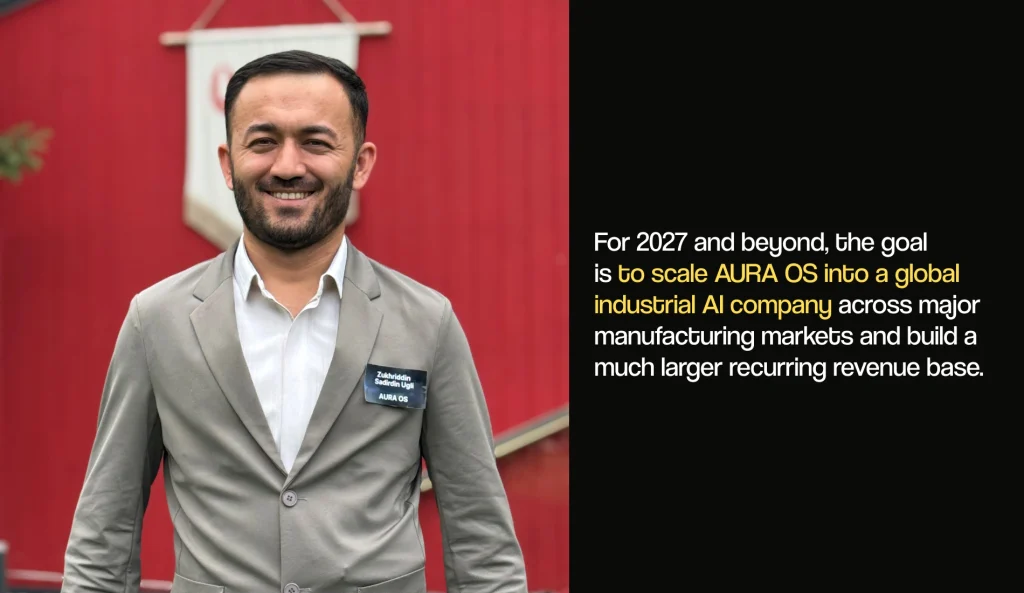
For 2027 and beyond, the goal is to scale AURA OS into a global industrial AI company across major manufacturing markets and build a much larger recurring revenue base.
The bigger mission is to help manufacturers become more productive, reduce hidden operational losses, improve working capital and increase effective production capacity. If we can do that at scale, it can contribute not only to individual companies but to stronger manufacturing competitiveness across the region and globally.
— And what revenue are you already generating?
— We have built a profitable, bootstrapped business with a growing customer base and significant enterprise traction.
We don't publicly disclose our exact revenue figures, and I prefer to distinguish clearly between realized revenue, signed contracts and pipeline opportunities. What I can say is that the business has reached a level of commercial validation that gives us confidence to invest in international expansion.
Our priority now is not simply to increase a headline revenue number. It is to convert international opportunities into recurring customers and build a scalable global revenue base.
— How does your financial model work?
— The model combines the AURA OS license and implementation with recurring AI-powered operational intelligence services for customers who want ongoing support and decision-making.
The recurring component is essentially a digital operations intelligence service for management. It continuously monitors operational information, identifies important issues, prioritizes them and helps management determine what action should be taken.
Our economics become increasingly attractive as we standardize implementation and shorten the time between signing a customer and getting them operational on the platform.
That scalability is very important to us. We want to serve significantly more manufacturing companies without our operating costs increasing at the same rate as the customer base.
— Are you looking for an investor right now?
— Yes. We are currently opening a $3 million funding round to accelerate international expansion.
I wasn't originally planning to raise institutional capital. We had built the business organically and were 100% bootstrapped, so I initially didn't see a strong reason to bring external capital into the company.
The accelerator experience changed my perspective. We realized that the biggest opportunity in front of us is international expansion. Enterprise sales cycles in global markets can be several months, and if we want to enter multiple markets simultaneously, we need resources for sales, implementation, partnerships and market presence.
So this is not capital to prove that the product works. We've already validated the product through years of working with manufacturing companies. The purpose is to accelerate something that is already working and take it into much larger markets.
Following our successful graduation from the Silkway Accelerator program within the Astana Hub–Almaty Hub and Google for Startups ecosystem, where we were recognized among the top startups, Astana Hub Ventures provided a $100,000 soft commitment. We are now going through the due-diligence and investment process to convert that soft commitment into a formal investment.
At the same time, several venture capital firms in Uzbekistan have approached us and expressed readiness to participate in the remaining portion of the round. We are currently in discussions and due diligence, and the level of interest gives us confidence that there is a realistic opportunity to close the round with regional investors in one financing round, subject to their investment processes and final approvals.
We are also seeing strategic interest from Kazakhstan around the opportunity to digitize industrial operations and contribute to the region's industrial AI ecosystem, alongside interest from investors in the UK and other international markets.
— What conditions would you need to be ready to work with an investor? Are you ready to give up part of your company? Should it be an investor from Central Asia, the Middle East, or the US? What's your priority?
— I'm open to giving up equity if the right investor can help us build a much larger company. But for me, the question is not simply who provides the capital.
I want strategic investors and experts who can bring enterprise relationships, market access, industry knowledge and international networks alongside capital.
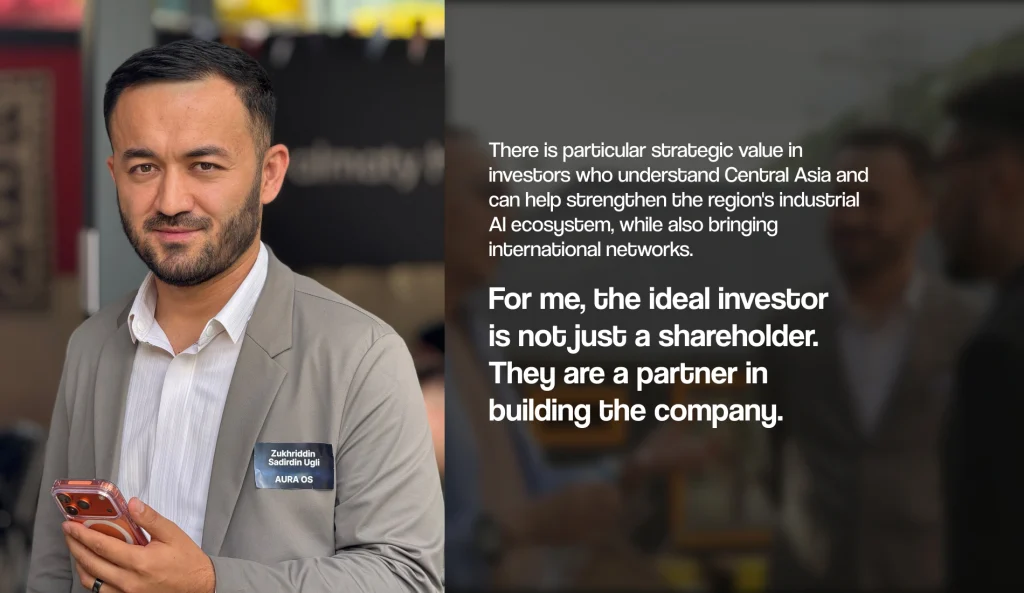
We are open geographically to investors from Central Asia, the Middle East, the US, Europe and Asia. There is particular strategic value in investors who understand Central Asia and can help strengthen the region's industrial AI ecosystem, while also bringing international networks.
We are also recruiting global-level commercial, technology and industry experts who can help us build relationships with enterprise customers, strategic partners and investors in international markets.
The purpose of the $3 million round is to solve the cash gap between entering new markets and generating revenue from them. Rather than entering markets one by one, we want to establish a presence in multiple markets simultaneously and accelerate AURA OS toward global scale.
There is also a broader strategic opportunity here. We believe the operational intelligence we are building can become valuable not only to individual manufacturers, but to the wider ecosystems around them — financial institutions, industrial groups, technology companies, system integrators and other strategic partners.
We started by solving problems for individual factories. Now our ambition is to make industrial operations more intelligent at scale. If we can help manufacturers produce more with the resources they already have, release capital trapped in operations, and make better decisions before losses happen, then we are building something much bigger than another enterprise software company.
For me, the ideal investor is not just a shareholder. They are a partner in building the company.
There are really three groups that matter to what we're building. Customers give us trust, time and technology budgets, and our responsibility is to create measurable operational value for them. Governments and strategic institutions can help accelerate industrial digitalization. And financial and strategic investors can provide the capital, relationships and international network needed to scale.
My priority is to build a global company, while remaining open to strategic partnerships and long-term opportunities that can create value for customers, investors and the broader industrial ecosystem.